
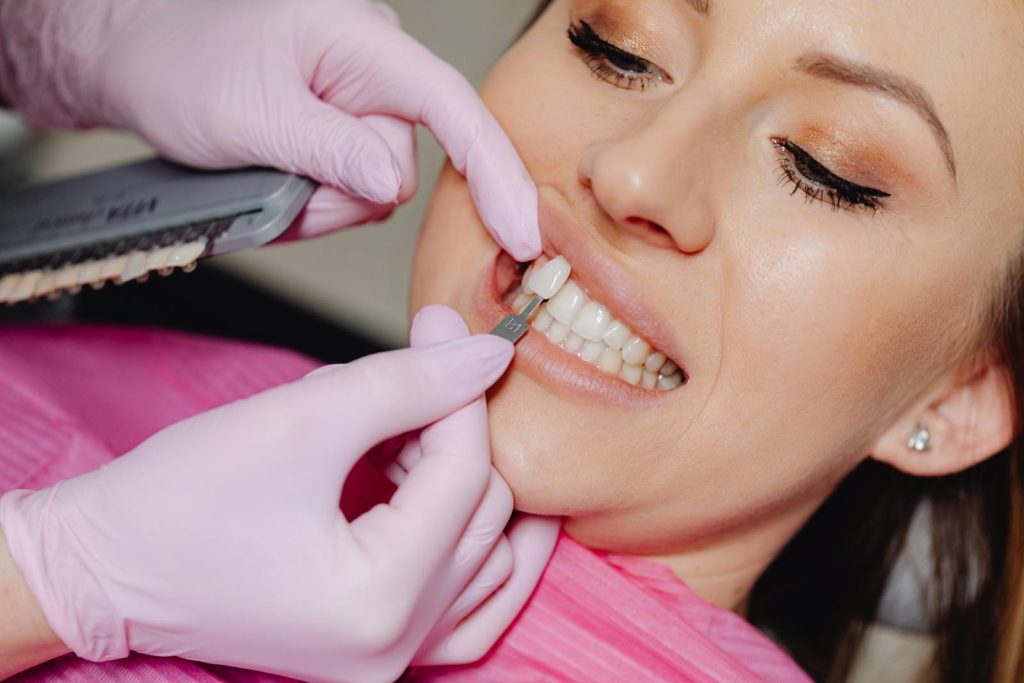
Close-up of a dental veneer being applied to a woman's teeth at a clinic.

Dental Veneers

About the Service

Dental veneers are ultra-thin, custom-made shells bonded to the front surface of teeth to improve both appearance and durability. These shells effectively address several cosmetic concerns. One common issue is stained or discolored teeth that resist whitening, which veneers can successfully cover. Furthermore, chipped, cracked, or worn teeth—as well as gaps, minor misalignment, uneven shapes, and worn enamel—can also benefit from this treatment by restoring strength and appearance.

Types of  Dental Veneers

Each type of dental veneers offers unique benefits depending on your dental needs and aesthetic goals.

TypeBest ForProsCons
Porcelain VeneersMost cosmetic casesHighly durable, natural translucencyRequires enamel removal (~0.5mm)
Lumineers®Minimal-prep casesNo drilling/no shots, reversibleLess stain-resistant, may appear opaque
Zirconia VeneersSeverely damaged teethStrongest option, ideal for structural issuesThicker, requires more tooth reduction

How Dental Veneers Work

Step 1: Consultation & Planning
  • Initially, your dentist will assess your tooth structure using digital scans and photographs to design your new smile.

  • In some cases, temporary veneers may be placed to give you a preview of the expected results.

Step 2: Tooth Preparation
  • For Porcelain/Zirconia: A small layer of enamel is removed.

  • For Lumineers: Minimal/no reduction needed.

  • Impressions sent to a dental lab (temporaries placed for 1–2 weeks).

Step 3: Bonding
  • Finally, the permanent veneers are carefully cemented onto your teeth using a UV light-activated resin.

  • Your dentist will then check your bite and polish the veneers to ensure maximum comfort and a natural appearance.

Step 4:Duration
  • The entire process typically takes 2 to 3 visits spaced 1 to 2 weeks apart.

  • Since local anesthesia is used during tooth preparation, you can resume normal eating as soon as the anesthesia wears off with no required downtime.

A dentist wearing gloves examines a patient's teeth in a close-up view during a dental check-up.

Ideal Candidates for Dental Veneers Treatment

  • Ideal candidates for dental veneers generally have healthy teeth and gums with no active decay or gum disease, which should be treated prior to the procedure.
  • Additionally, sufficient natural enamel is needed for bonding, except in cases where no-prep Lumineers® are chosen.
  • Veneers are particularly beneficial for individuals with stubborn stains, chipped teeth, or irregular shapes.

Success Stories

Read our glowing reviews from satisfied customers.

5/5

They are very gentle and do their best to give the patients the expected results. I am very happy with their office, equipment, kindness and professionalism.

5/5

The staff was friendly and professional, and the treatment left me feeling refreshed and rejuvenated. Thank you for the wonderful service, I'll definitely be visiting again!

5/5

The treatment targeted areas of concern and helped to improve the texture and firmness of my skin, but most importantly, the staff knew what they were doing.

have a question?

Quick answers to questions you may have

Q1: Do veneers ruin your natural teeth?

A: Porcelain veneers require enamel removal, but Lumineers don’t. Both protect underlying teeth.

Q2: Can veneers be whitened?

A: No—they resist stains but don’t respond to whitening. Choose your shade carefully!

Q3: Are veneers painful?

A: Numbing ensures comfort; mild sensitivity may occur post-procedure.

Q4: What if a veneer chips?

A: Small chips can be polished; larger damage requires replacement.

Message Us on WhatsApp